
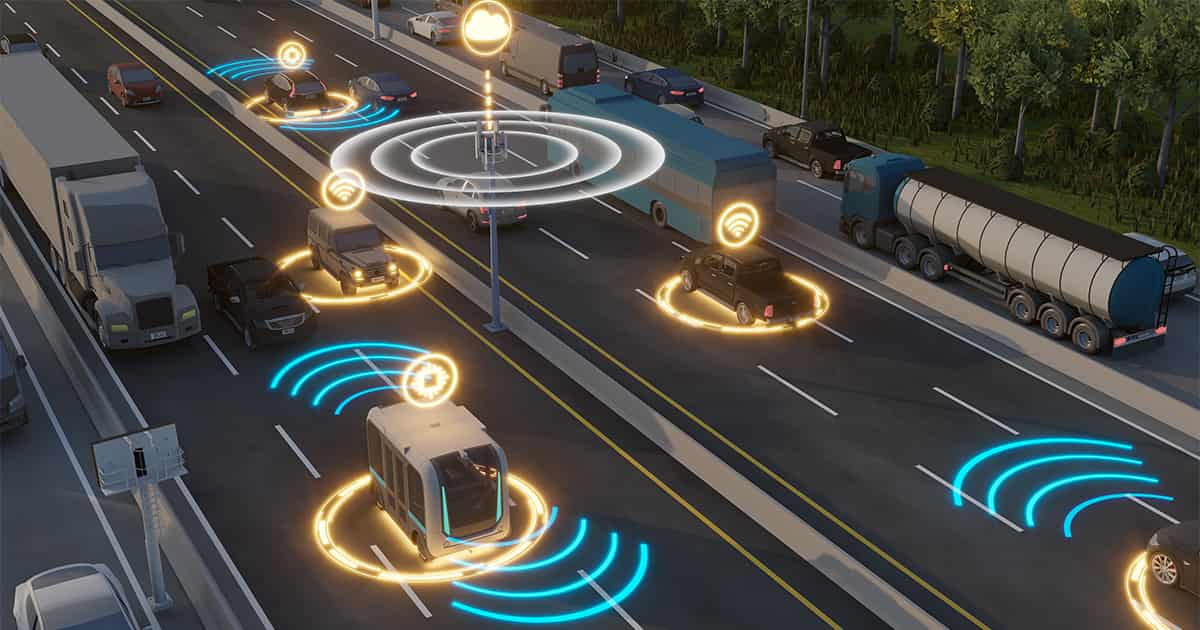
Smart roads represent a fundamental reimagining of transportation infrastructure through the integration of Internet of Things (IoT) sensors, 5G networks, artificial intelligence, and advanced data analytics. The global smart highway market has expanded to approximately $68.77 billion in 2024 and is projected to reach $165-198 billion by 2030, growing at 19-20% annually. These intelligent systems deliver measurable impact across three critical dimensions: efficiency (8-25% travel time reduction), safety (40% faster emergency response), and sustainability (up to 21% emissions reduction). Unlike passive infrastructure of the past, smart roads actively optimize traffic flow in real time, predict maintenance needs before failures occur, and provide the foundation for autonomous vehicle integration—fundamentally altering how people and goods
How Smart Roads Work
Smart roads operate through a layered technological architecture combining physical sensors embedded within road surfaces with cloud-based software systems that process real-time data from thousands of sources simultaneously. At the foundation, IoT devices—including magnetometers, accelerometers, pressure sensors, and optical cameras—continuously monitor road conditions, traffic patterns, vehicle speeds, and environmental factors. This data flows through 5G networks capable of transmitting at speeds up to 20 gigabits per second with latency as low as 1 millisecond, enabling instantaneous decision-making across highway networks.
The critical innovation lies in Vehicle-to-Infrastructure (V2I) and Vehicle-to-Everything (V2X) communication protocols. Rather than operating in isolation, connected vehicles transmit data to roadside infrastructure, which processes signals and broadcasts optimized instructions back to traffic signals, dynamic message boards, and navigation systems. Artificial intelligence systems running on this data generate predictive models that forecast congestion up to one hour in advance, enabling proactive rather than reactive traffic management. For instance, AI-powered adaptive traffic signals respond in real time to actual traffic volume rather than fixed time schedules, dynamically adjusting signal phases to smooth vehicle progression and reduce stop-and-go driving patterns that waste fuel and increase emissions.
Core Applications and Real-World Impact
Traffic Flow Optimization
Smart roads deliver measurable improvements in urban mobility. Studies across U.S. metropolitan areas show intelligent transportation systems (ITS) reduce travel times by 8-25%, with some pilot zones achieving 20-30% reductions in traffic delays. Real-time traffic monitoring through embedded sensors allows traffic operators to detect bottlenecks within seconds and implement dynamic responses—redirecting vehicles to alternate routes, adjusting signal timing, or activating variable speed limit signs to optimize flow. Singapore’s electronic road pricing system combined with real-time traffic management demonstrates this principle at scale: intelligent routing and toll adjustments save the city’s logistics sector $40 million annually.
Autonomous and Connected Vehicle Support
The infrastructure requirements for autonomous vehicles differ fundamentally from conventional roads. Smart highways provide the precise positional data, real-time hazard warnings, and coordinated signal timing that autonomous systems require to operate safely alongside human-driven traffic. Vehicle-to-Infrastructure communication allows autonomous vehicles to receive advance notice of signal changes, enabling smooth acceleration and deceleration patterns that conserve energy and enhance safety. This V2I integration proves particularly valuable during mixed-traffic scenarios where autonomous vehicles gradually integrate into networks dominated by human drivers.
Emergency Response and Safety
Federal Highway Administration studies of 5G-connected vehicle corridors document that accident response times decreased by 40% compared to traditional systems. When a collision occurs, connected vehicles automatically report the incident to traffic management centers, which simultaneously activate emergency preemption protocols on traffic signals, broadcast alerts to approaching drivers through dynamic signage, and reroute traffic to minimize secondary accidents. This dual approach—reducing time-to-response while simultaneously limiting exposure to hazards—directly translates to lives saved.
Electric Vehicle Infrastructure Integration
Smart roads increasingly serve as platforms for EV charging infrastructure. Detroit’s wireless charging roadway, which became operational in November 2023, features inductive charging coils embedded beneath 14th Street that transfer energy to vehicles as they drive, using technology similar to smartphone wireless charging. This innovation addresses a critical barrier to EV adoption: range anxiety. Rather than requiring dedicated charging stations, EVs can maintain charge levels throughout their commutes, effectively eliminating the need for stationary charging infrastructure for many use cases. Expansion plans in Detroit envision electrified corridors in Corktown and along Michigan Avenue.
Economic and Environmental Dimensions
Cost-Benefit Economics
The Intelligent Transportation Society of America quantifies the financial return on smart road investment at a 9:1 benefit-to-cost ratio, indicating that every dollar spent on ITS infrastructure generates nine dollars in economic returns. These gains accrue through multiple channels: fuel savings from optimized routing, reduced maintenance costs from predictive repairs, improved labor productivity from shortened commutes, decreased accident-related losses, and lower vehicle operating costs from reduced idling and wear.
Predictive maintenance exemplifies this economic logic. Smart roads detect pavement degradation, structural fatigue, and safety hazards through embedded sensors before failures occur, enabling targeted repairs that cost substantially less than emergency interventions. This approach extends road lifespan while minimizing traffic disruptions that typically accompany conventional maintenance cycles.
Fleet operators experience particularly substantial returns. Logistics companies deploying ITS-integrated fleet management systems report 10-20% productivity improvements, while advanced routing algorithms that account for road grades, traffic density, and weather conditions reduce fuel consumption for heavy vehicles by optimizing speed profiles and enabling platooning—where trucks travel in close formation to reduce air resistance.
Environmental and Emissions Impact
Smart roads reduce transportation-related emissions through multiple mechanisms. Optimized traffic flow eliminates unnecessary idling and stop-and-go driving—the primary sources of urban air pollution. European studies document that ITS technologies reduce CO₂ emissions by up to 21% through improved traffic flow and route efficiency. In Beijing, a deep reinforcement learning-based traffic management system achieved 25% CO₂ reduction specifically during peak hours, when emissions concentrations reach dangerous levels. On busy metropolitan corridors, 5G-connected vehicle systems reduce emissions by 15% through optimized traffic patterns and coordinated vehicle movement.
Beyond tailpipe emissions, smart roads enable the broader transition to electric and sustainable transportation. Cities like Tel Aviv have deployed electric roads using wireless power transfer, eliminating fuel consumption for buses and commercial vehicles entirely. Copenhagen’s integrated smart city platform combines traffic optimization with air quality monitoring and waste optimization, creating a closed-loop system where transportation decisions factor in real-time pollution levels and adjust routing to minimize exposure in sensitive areas.
Market Growth and Regional Deployment
The smart highways market exhibits rapid expansion driven by urbanization, government infrastructure initiatives, and technological maturation. Market size projections vary by research firm but converge around consistent growth trajectories: from approximately $57-69 billion in 2023-2024 to $165-198 billion by 2030, representing compound annual growth rates of 19-20%. This growth distributes unevenly across regions, with distinct drivers in each market.
Europe represents the current largest market, driven by stringent regulatory requirements for road safety (Vision Zero initiatives) and emissions reductions (EU climate targets). Infrastructure investments supporting cross-border freight movement within the EU create demand for seamless, connected corridor systems. North America accounts for $590 million of the market in 2024, with federal and state-level initiatives—particularly the U.S. Department of Transportation’s V2X Deployment Plan targeting 2030 adoption milestones—accelerating deployment. Asia-Pacific represents the fastest-growing region, with cities like Singapore and emerging smart city initiatives in GCC countries positioning themselves as regional hubs for smart transportation technology.
Technological Foundation: 5G and IoT Integration
Fifth-generation wireless networks provide the critical infrastructure enabling real-time smart road operations. Unlike previous wireless generations requiring seconds or minutes for communication, 5G achieves 1-millisecond latency, making simultaneous two-way communication between thousands of road sensors, vehicles, and traffic management centers feasible. This performance proves essential for safety-critical applications: autonomous vehicles evaluating collision avoidance must process incoming data and execute responses within milliseconds, a requirement impossible under older network standards.
IoT sensor proliferation continues accelerating. Embedded sensors monitor pavement condition, structural integrity, weather conditions, traffic speed, vehicle weight distribution, and air quality. As sensor costs decline and wireless transmission becomes ubiquitous, comprehensive sensor coverage becomes economically viable even for secondary roads. This density of instrumentation generates data volumes that historically would have overwhelmed processing capabilities—a challenge addressed through edge computing, which performs preliminary analysis at the roadside before transmitting only actionable insights to central systems.
Implementation Models and Current Deployments
Several distinct implementation models have emerged across different regions:
Singapore Model: Electronic toll collection combined with real-time traffic optimization represents Singapore’s approach, leveraging AI and sensor networks to manage one of Asia’s busiest transportation corridors. The system prioritizes goods movement in a city-state positioned as a global logistics hub, with infrastructure optimization directly supporting economic development objectives.
European Sustainability Model: Copenhagen’s integrated approach combines smart traffic with environmental monitoring, waste management, and renewable energy systems. The city’s roadmap toward carbon neutrality by 2025 treats smart roads as one component of a broader decarbonization strategy, with specific initiatives to prioritize public transit and cycling alongside vehicle traffic optimization.
North American Infrastructure Model: Detroit’s wireless charging corridor and Michigan’s broader electrified roadway initiative treat smart roads as EV charging infrastructure, addressing the specific constraint of limited public charging stations. This model positions smart road investment as complementary to the broader electric vehicle transition.
Emerging Technology Model: Japan’s AutoFlow project for autonomous cargo pods and multiple pilot projects testing dynamic wireless charging represent frontier applications where smart roads serve as dedicated environments for emerging mobility concepts rather than adapting to existing vehicle fleet patterns.
Critical Challenges and Implementation Barriers
Despite substantial growth projections and demonstrated benefits, smart road deployment faces formidable obstacles that constrain adoption rates and create implementation bottlenecks.
Cybersecurity and Critical Infrastructure Vulnerability
The connectivity that enables smart road benefits simultaneously creates cyber vulnerabilities. Ransomware attacks represent 38% of transportation sector incidents, with data breaches (30%) and malware (17%) following as primary threats. Unlike legacy transportation systems where traffic signals operated as isolated electrical devices, modern smart roads integrate IoT sensors, traffic management centers, and cloud platforms across networked systems. A compromised field sensor can potentially serve as an entry point into a traffic management center’s network, analogous to how HVAC systems became vulnerabilities in corporate breaches.
The challenge extends beyond isolated incidents. Transportation agencies struggle with cybersecurity maturity fundamentally. Penetration testers routinely discover IoT devices equipped with default passwords, outdated software, and basic security oversights. Recent audits reveal highway devices accessible from the public internet lacking fundamental authentication protocols. The distributed nature of road networks—potentially encompassing thousands of sensors across vast geographies—makes comprehensive security hardening technically difficult. It requires only a single neglected device to provide attackers a foothold for network infiltration.
Supply chain vulnerabilities compound these risks. Third-party service providers, construction firms, and IT contractors accessing highway networks for maintenance create multiple vectors for intrusion. The 2017 NotPetya attack, which spread through accounting software, demonstrated how trusted supply relationships can become conduits for malicious code. Highway agencies address these risks through enhanced procurement standards (requiring ISO 27001 and IEC 62443 compliance) and network segmentation isolating critical control systems, but comprehensive hardening remains incomplete.
Standardization and Interoperability
The absence of unified technical standards creates fragmentation across regional implementations. Different manufacturers produce incompatible sensor systems, communication protocols, and traffic management software. This heterogeneity prevents seamless operation across jurisdictional boundaries, complicating freight movement and reducing the network effects that justify high capital investment. While standards-setting bodies (ISO, IEEE, and regional regulatory agencies) continue developing frameworks, widespread adoption remains incomplete, forcing agencies to make lock-in decisions with individual vendors.
Capital Investment Requirements
Converting existing transportation infrastructure to smart roads requires substantial capital investment. Sensor installation, network buildout, traffic management center systems, and software platforms necessitate upfront expenditures measured in hundreds of millions for regional deployment. While long-term economic returns justify these investments (the 9:1 cost-benefit ratio), municipalities and national governments face budget constraints limiting deployment rates. This capital intensity creates a bifurcated landscape where wealthy jurisdictions rapidly deploy advanced systems while less developed regions lack resources, potentially exacerbating transportation inequalities.
Rural and Remote Implementation
5G network deployment concentrates in urban areas where population density justifies infrastructure investment. Extending 5G coverage to rural highways remains economically challenging, creating a digital divide in transportation infrastructure. Smart road benefits—particularly incident detection and emergency response optimization—prove valuable even in low-traffic regions, yet business cases for deployment become marginal when spread across sparse traffic volumes.
Conclusion: The Future of Mobility
Smart roads represent the foundational infrastructure enabling the transportation systems of the next two decades. By integrating real-time data, artificial intelligence, and vehicle-to-infrastructure communication, these systems optimize traffic flow, enhance safety, reduce environmental impact, and create the operational foundation for autonomous vehicle integration. Market growth projections of $165-198 billion by 2030 reflect genuine business opportunity and government commitment to infrastructure modernization.
Yet implementation challenges—particularly cybersecurity vulnerabilities, standardization gaps, and capital requirements—create realistic constraints on deployment rates. Success requires sustained government investment, private sector innovation in security protocols, and international coordination on technical standards. Cities like Singapore and Copenhagen demonstrate that smart roads deliver transformational benefits when deployed comprehensively as part of broader urban mobility strategies.
The question facing transportation planners is not whether smart roads represent the future direction of infrastructure investment, but rather the pace and geographic distribution of that transition. Regions achieving early deployment capture competitive advantages in logistics, economic development, and urban livability. The transformation has commenced; execution timing remains the critical variable determining which cities and regions benefit first.