
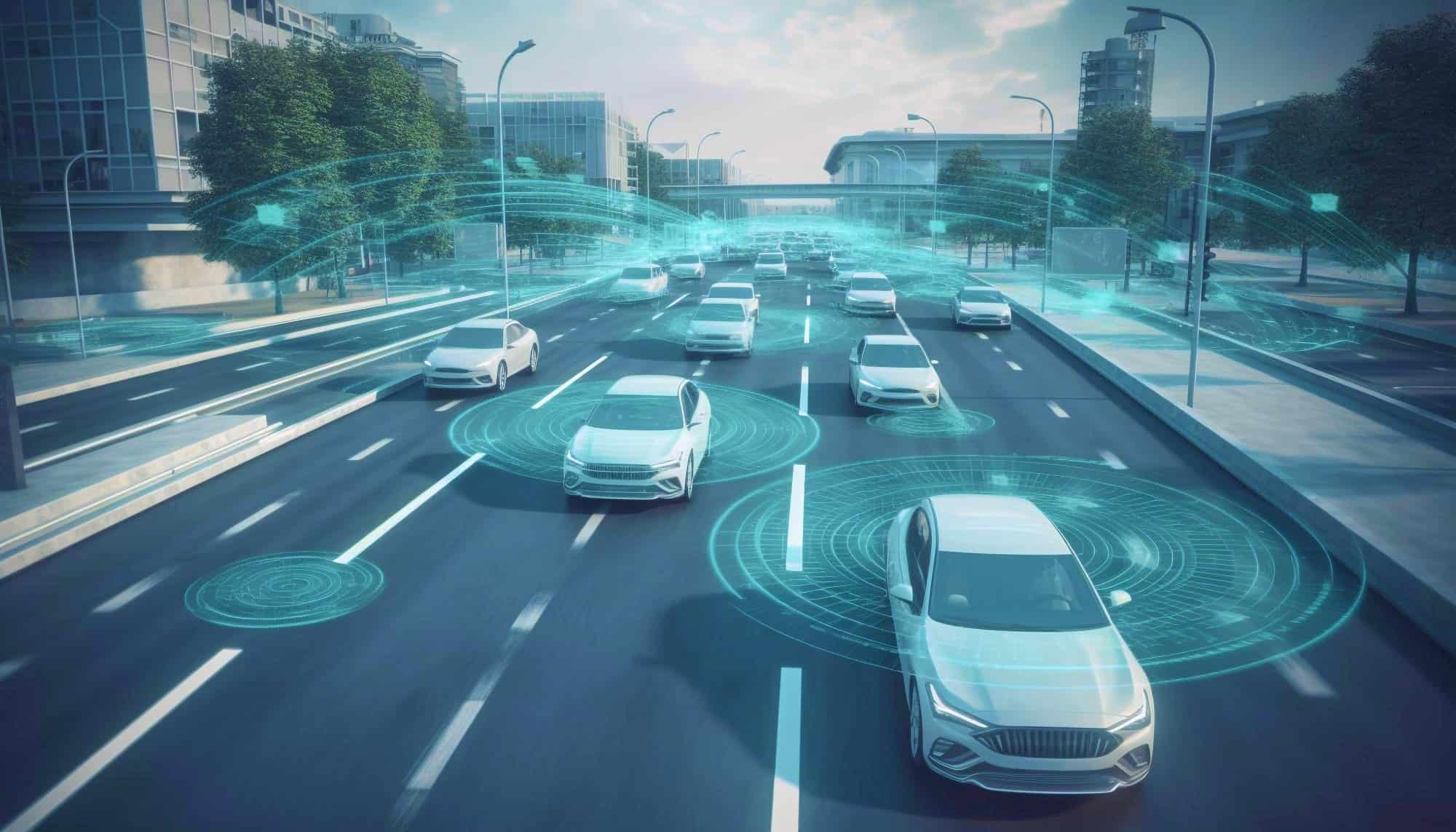
Artificial Intelligence (AI) has transitioned from a theoretical safety concept to a critical operational layer in global transportation. By shifting road safety from reactive (post-accident analysis) to predictive (pre-accident prevention), AI systems are delivering measurable reductions in mortality and economic loss. Early implementations in major cities have demonstrated accident clearance time reductions of 30% and response time improvements of up to 95%.
For decision-makers, the value proposition extends beyond compliance; it encompasses significant operational cost reductions—up to 40% in collision rates and 25% in vehicle repair costs—driven by three core technologies: Computer Vision, Predictive Analytics, and Vehicle-to-Everything (V2X) communication.
1. The Core Mechanisms: How AI Prevents Accidents
AI improves safety not by replacing human judgment immediately, but by augmenting it with superhuman perception and reaction times.
A. Computer Vision & Object Recognition
Computer vision systems function as the “eyes” of modern safety infrastructure. Unlike standard cameras that simply record, these systems process visual data in milliseconds to identify hazards.
- Technical Function: Uses Convolutional Neural Networks (CNNs) to classify objects (pedestrians, debris, signage) even in low-visibility conditions (fog, night).
- Application: In autonomous emergency braking (AEB), the system calculates “time-to-collision.” If a human fails to brake, the AI intervenes.
- Impact: Systems like Smart Eye and other driver monitoring tools have shown to reduce immediate crash risk by approximately 10% by detecting distraction and fatigue.
B. Predictive Analytics & Digital Twins
Rather than waiting for accidents to happen, AI uses historical data to predict where they will happen.
- Mechanism: Algorithms (such as Random Forest and Decision Trees) analyze vast datasets—weather patterns, traffic density, and historical crash data—to assign “risk scores” to specific road segments in real-time.
- Digital Twins: Cities create virtual replicas of their road networks. Simulations run millions of crash scenarios to test safety interventions before physical implementation.
- Result: Digital twin simulations have demonstrated a potential 40% reduction in collision rates compared to conventional safety planning.
C. V2X (Vehicle-to-Everything) Communication
V2X creates a “hive mind” where vehicles share data with each other and infrastructure.
- V2V (Vehicle-to-Vehicle): A braking car transmits a signal to the car behind it milliseconds before its brake lights even activate, preventing pile-ups.
- V2I (Vehicle-to-Infrastructure): Traffic lights communicate with approaching cars. If a car is predicted to run a red light, the intersection can hold cross-traffic at red to prevent a T-bone collision.
2. Economic Impact & ROI Analysis
The integration of AI into road safety is reshaping the economics of fleet management and insurance.
Cost Reduction Metrics
Deploying AI-driven safety measures yields substantial direct savings. Research indicates that AI-optimized fleets and infrastructure can achieve:
| Metric | Reduction / Benefit | Source |
|---|---|---|
| Collision Rate | 40% reduction via predictive simulations | |
| Medical Expenses | 30% decrease due to lower accident severity | |
| Vehicle Repair Costs | 25% reduction | |
| Insurance Savings | ~$240 annual savings per vehicle via telematics | |
The Insurance Transformation (Telematics)
The insurance sector is pivoting from static demographics (e.g., “male, under 25”) to dynamic Usage-Based Insurance (UBI).
- Telematics: AI analyzes driving behavior—harsh braking, cornering speed, phone usage.
- Business Case: Fleets using these systems can negotiate lower premiums. In Canada, telematics-based policies have demonstrated ability to lower damage claims costs from $900 to $660 per year, a distinct competitive advantage for logistics companies.
3. Global Implementation & Case Studies
Real-world deployments confirm the efficacy of these systems across diverse urban environments, including significant progress in Latin America.
Latin America Focus
- Buenos Aires, Argentina: The city implemented an AI-driven incident classification system to automate the processing of police accident reports.
- Impact: Data processing time dropped from 480 hours to 24 hours per year, with classification accuracy exceeding 94%. This speed allows authorities to identify and remediate high-risk intersections weeks faster than before.
Global Benchmarks
- Istanbul: Deployed AI-based traffic signal optimization.
- Impact: 95% reduction in incident response time and a measurable decrease in accident frequency at high-risk intersections.
- Singapore: Utilizes thousands of cameras feeding into an AI grid.
- Impact: 30% decrease in accident clearance times, reducing secondary accidents (crashes caused by sudden traffic stops from a primary accident).
- Los Angeles: Predictive traffic management predicts congestion hotspots.
- Impact: Up to 20% reduction in traffic delays, indirectly reducing driver frustration and associated aggressive driving behaviors.
4. Strategic Challenges & Risks
While the technology is mature, the operational environment poses distinct challenges that leaders must navigate.
- Cybersecurity & “Adversarial Attacks”: Connected vehicles are vulnerable. Hackers can use “adversarial images”—stickers on a stop sign that look like graffiti to a human but trick an AI into seeing a “Speed Limit 45” sign. This “data poisoning” is a critical vulnerability for autonomous fleets.
- Liability Vacuums: If an AI algorithm chooses a maneuver that causes a crash to avoid a worse one, who is liable? The coder? The fleet manager? The manufacturer? Legal frameworks are currently lagging behind technical capability, creating uncertainty for early adopters.
- Infrastructure Gaps: AI systems rely on clear lane markings and readable signage. In regions with degrading infrastructure, computer vision systems may disengage or fail, limiting their effectiveness to well-maintained urban corridors.
5. Future Outlook (2025–2030)
The market for road safety software is projected to double, growing from $6.69 billion (2025) to $12.39 billion (2030). The next frontier is Predictive Enforcement: AI that doesn’t just ticket speeding drivers, but identifies patterns of reckless behavior across a city to guide police deployment proactively.
Recommendation: For stakeholders in logistics or urban planning, the window to treat AI safety as an “optional add-on” has closed. It is now a primary lever for cost control and risk management. Implementing video telematics and V2X readiness should be a priority for the next fiscal cycle.